Convocation Address
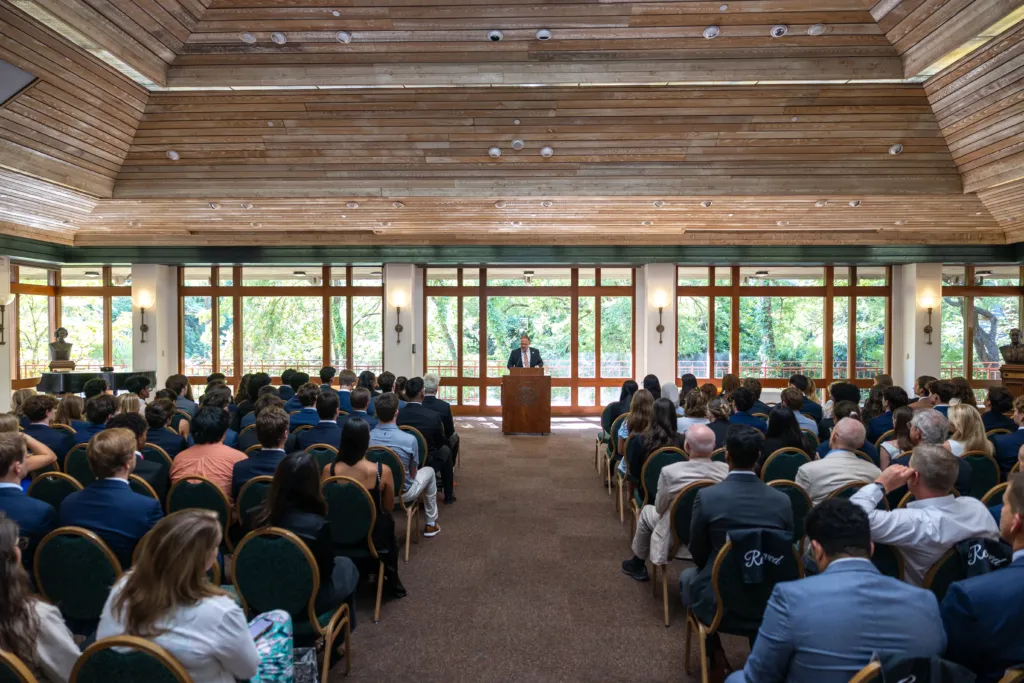
Convocation Address
Dean Justin Dyer
August 28, 2025
The great philosopher Homer Simpson once said that “Being popular is the most important thing in the world.” We laugh, because we know it isn’t true – but the joke is that at different points in our lives we all act like it is true. I thought of that recently when rereading C.S. Lewis’ 1944 address to students at King’s College in London.
Lewis gave the talk at the end of World War II, just before the Battle of the Bulge, the last major German offensive on the Western front. Most of the students at King’s College had spent their entire university years under air raids, rationing, and the uncertainty of wartime London. They were about to graduate to a world at war. Many dons and students had already fought; some had died.
King’s College was one of the places where Britain’s future leaders were forged – and Lewis offered a spiritual survival guide for those about to shoulder public responsibility at a time when civilization hung in the balance. Lewis chose, on that occasion, to speak to the students about the danger of craving to be in the know, to belong to the right group, and to have insider status.
One of the dominant elements of human experience for most of us, for at least parts of our lives, is – as Lewis said – “the desire to be inside the local Ring and the terror of being left outside.” In childhood, it may be the clique, the team, or the social media followers. In college, it may be the sorority or fraternity, the prestigious fellowship, the elite law school, the secret society, the political tribe, or just being one who received an invitation to the most exclusive party. In adult life, after college, there are a thousand more Rings, and an endless desire to be in the know, among these people, in a position of influence, invited to those events, running in this circle, living in that neighborhood, among the few who have achieved this or who have done that.
Elite status, social groups, inner circles, influence, secret knowledge – these things are not bad or evil, but they are dangerous, especially for bright, young, motivated, ambitious honors students at the best university in the best state in the best country in the world. If being “in” is your dominant motivation, you’ll never be satisfied. There will always be another Inner Ring still further in, another group whose recognition you crave, another inner circle of influence you want to enter, angling and jockeying for power and position and prestige, with a continual pull to sacrifice the things that are truly good in life – including your own character and integrity – for this elusive and unsatisfying thing. When you do get into some Inner Ring, what you will find is ambition and self-interest and striving but not virtue, kindness, or loyalty.
The Inner Ring, sought on those terms, is not where you will find meaning or where you will find your true friends. And so Lewis told these students about the embark on a world torn apart: “Unless you take measures to prevent it, this desire is going to be one of the chief motives of your life . . . [and] whether by pining and moping outside Rings that you can never enter, or by passing triumphantly further and further in—one way or the other you will be that kind of man.” That kind of man, having lived that kind of life, will in the end be what Lewis called a scoundrel – unscrupulous, treacherous, ruthless, and without real friends.
“The quest of the Inner Ring,” Lewis said, “will break your hearts unless you break it.” The way to break it is through honest work and honest friendship. And if you do break the quest for the Inner Ring, a surprising thing will happen. You’ll make the work about the work, pursuing excellence in your craft. You’ll find yourself among others doing the same, and together you’ll take responsibility for the success of your organization or your field. If you pursue hobbies and avocations that genuinely interest you, that you love for their own sake, you will find yourself surrounded by others who share those interests and passions – and real friendships will blossom – and probably some networking opportunities, too, but that won’t be the point. If you choose what to do because you love it, because you have a gift and an interest and a sense of purpose, and not because you want to be “in” with the right people, you will likely end up in a position of leadership and influence – there is a certain paradox here – but it will have been for the right reasons, pursued in the right way.
Why bring all of this up at the convocation for the first class of the School of Civic Leadership? Because our hope is that you will develop true friendships oriented around a shared love of wisdom, knowledge, and study. Your study will be anchored by the vision for the university summarized by the Latin motto in our seal, proposed by William Battle in 1903: Disciplina Praesidium Civitatis. It is a short Latin rendering of a famous quote from Mirabeau Lamar, the second president of the Republic of Texas, from his address to the Texas Congress in 1836: “Cultivated mind is the guardian genius of democracy.” In our Latin motto, the translation is literally “study is the guardian of the city.”
The focus of your study in the School of Civic Leadership will be on the spiritual and intellectual roots of Western civilization, especially the encounter between biblical religion and classical philosophy, the twin-chambered heart of Western civilization for millennia; history of America’s establishment of free government under a written constitution, and America’s struggle to realize the aspirations its founding; defense of America’s interests abroad and her place among the nations of the world; economic policies and business culture that promote prosperity and human flourishing; and the skills, principles, values, and aptitudes necessary for leadership in a free society.
We will not all agree with each other. Your professors have different interpretations and different outlooks. They each ask different questions and give different answers. We expect the same from you. You come from different schools, different states, different backgrounds. Have the courage to say what you think, be respectful of others, consider that they may be right and you may be wrong. Be willing to change your mind. Be grateful if someone helps you look at the world in a different way. Cherish these four years. It is a unique time of life, and you will never have the opportunity to sit, think, read, and debate in this kind of community, in quite the same way, again.
The aim of your study in the School of Civic Leadership is truth and freedom. Ninety years ago, in 1935, a faculty committee led by William Battle recommended an inscription for the Main Building on campus: “Ye shall know the truth and the truth shall make you free.” When the faculty proposed this to the Regents, Battle explained: “Truth and freedom are so essentially the foundation of education, character, and progress that the injunction to seek truth as a means to freedom is as splendid a call to youth as we can make.”
The Oxford English Dictionary offers several definitions of freedom. One of them is “the state or fact of not being subject to a despotic or foreign power.” Freedom, in this sense, is self-government. It is the self-government of the individual who is not subject to the despotic powers of his own passions or appetites and is not subject to the arbitrary, irrational, willful control of another. And it is the self-government of a community of free individuals taking responsibility for their own affairs, free of the despotic powers of foreign adversaries.
This sense of freedom as self-government brings together each of the themes, and areas of study, of our school. Mirabeau Lamar’s full quote, which we often forget, is that “Cultivated mind is the guardian genius of democracy, and while guided and controlled by virtue, the noblest attribute of man. It is the only dictator that freemen acknowledge, and the only security which freemen desire.” When Battle proposed this for the UT Seal, he said that it was “at once a justification of the university’s existence and an ideal of its future.” The School of Civic Leadership advances that tradition at UT Austin.
After your study, we want you to go out into the world and get good jobs, get into good graduate schools, build businesses, take responsibility for your families and communities, and form networks of influence that have a positive impact on the world. But we hope those things flow first from a shared love of what we are doing and what we are studying together.
We have a unique moment.
We have a unique opportunity.
Let’s build something significant, as friends together, in the pursuit of truth and freedom.